

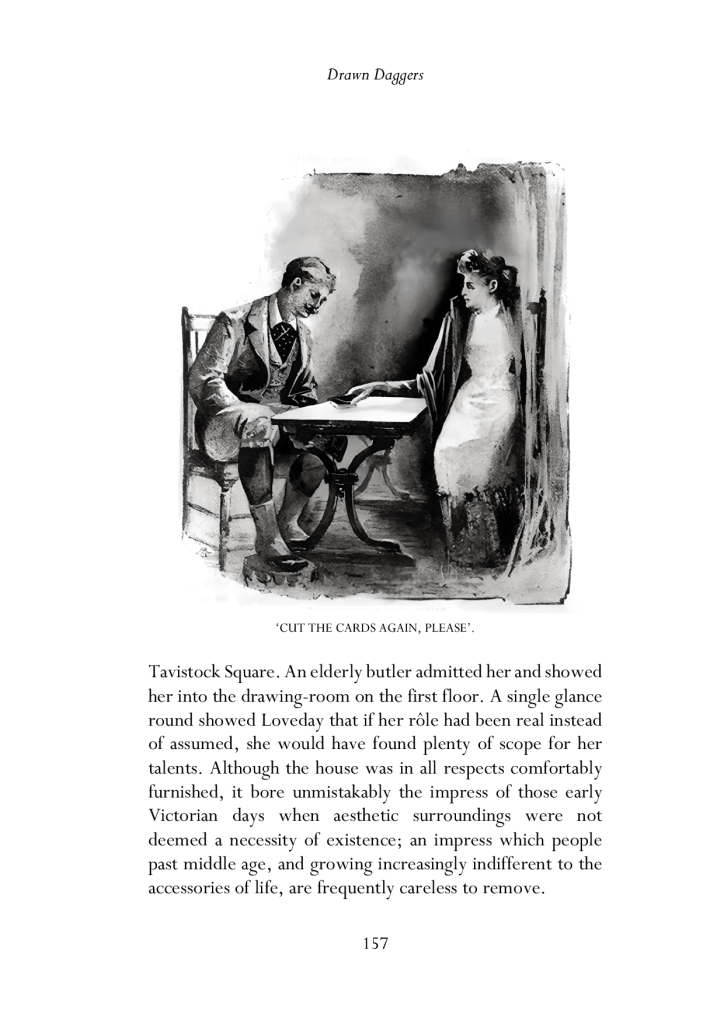
The Experiences of Loveday Brooke
Catherine Louisa Pirkis
£7.99 Paperback
£5.99 Kindle
(Also available for iBooks)
Definitive edition: A.I. restored illustrations and new critical introduction
Victorian London: Meet Loveday Brooke, dubbed the ‘female Sherlock Holmes’, the first female detective in the history of the genre (originally published in 1894). From missing jewels to fraudulent spiritualists, the seven stories keep the reader guessing until the end. Illustrated throughout, contemporary A.I. restoration brings the original Victorian artwork back to life. This new edition is a must-have for fans of classic detective fiction and anyone who loves a good mystery.
Contents: Introduction | 1.The Black Bag Left on a Door-step | 2.The Murder at Troyte’s Hill | 3.The Redhill Sisterhood | 4.A Princess’ Vengeance | 5.Drawn Daggers | 6.The Ghost of Fountain Lane | 7.Missing!
Catherine Louisa Pirkis (1839-1910) published 14 novels and contributed to numerous periodicals. Her first major novel, Disappeared from Her Home, was a first foray into the mystery genre, serving as a prelude to the creation of Loveday Brooke, for which Pirkis is best known.


Pécuchet Press, 2023
978-1-7397669-6-2 (paperback)
978-1-7397669-7-9 (kindle)
978-1-7397669-8-6 (ebook)
A.I. Restored Illustrations
A newly compiled edition, The Experiences of Loveday Brooke offers the reader the opportunity to enjoy the stories once again. Not least due to the digital ‘restoration’ of the original illustrations using new generation AI image software (making them suitable once more for print publication).
The original Hutchinson & Co. edition of The Experiences of Loveday Brooke, Lady Dectective, published in 1894 can be tracked down in the British Library, as can the original publictions of the stories serialised in The Ludgate Illustrated Magazine (in 1893–94). Although, it is by no means straightforward. There are also many amateur publications of the text available via Amazon, yet these do not inlcude the illustations. The full text and illustrations, The Experiences of Loveday Brooke, Lady Detective, are nonethless available open acess at UPenn Digital Library.
However, the images available via UPenn are in low-resolution format, making them unsuitable for print publication. In order to produce a new, affordable print edition, it was necessary to ‘restore’ the images using AI imaging software. In this case, the Zyro AI Image Upscaler (Hostinger International, Ltd.). This free-to-use tool performs the previously impossible task of increasing image resolution. While it is very easy to reduce resolution (a task regularly performed when saving images as JPEG files, for example, which algorithmically strip out ‘noise’ typically undetected by the human eye), it was never before possible, nor conceivable to improve image resolution.
In a technical sense it is still not possible to perform this task, but what AI software is capable of doing is ‘re-rendering’ pictures to appear like the original. As Zyro’s website explains:
To upscale an image without losing quality, [the tool uses] deep convolutional neural networks. You could say it’s like a brain, but a computer one. These networks are trained on big datasets of images, so they learn the basic properties of all kinds of images. For example, if the computer sees a low-resolution picture of a brick wall, it will know what the texture of brick looks like and will fill in the details of the brick wall. This way, the image becomes more realistic. Before machine learning and artificial intelligence, when you wanted a bigger image, you needed to repeat pixels 2 or more times to make the image bigger — but you’d still end up with a blocky-looking and blurry image. (Zyro AI Image Upscaler)
To give a sense of what was achieved in using this tool, you can compare the following illustrations as used in the new edition of The Experiences of Loveday Brooke, with the original low resolution file on the left, the new AI-enhanced image on the right:
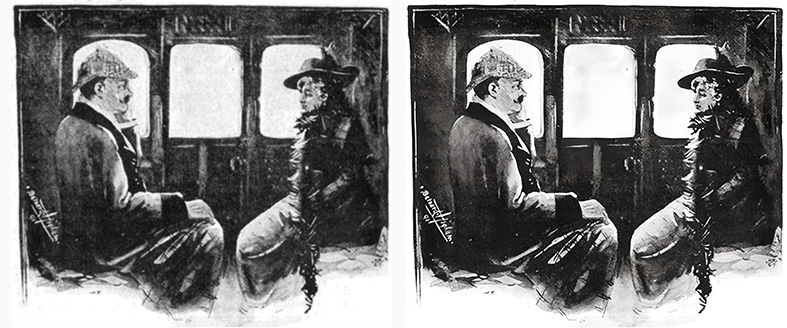
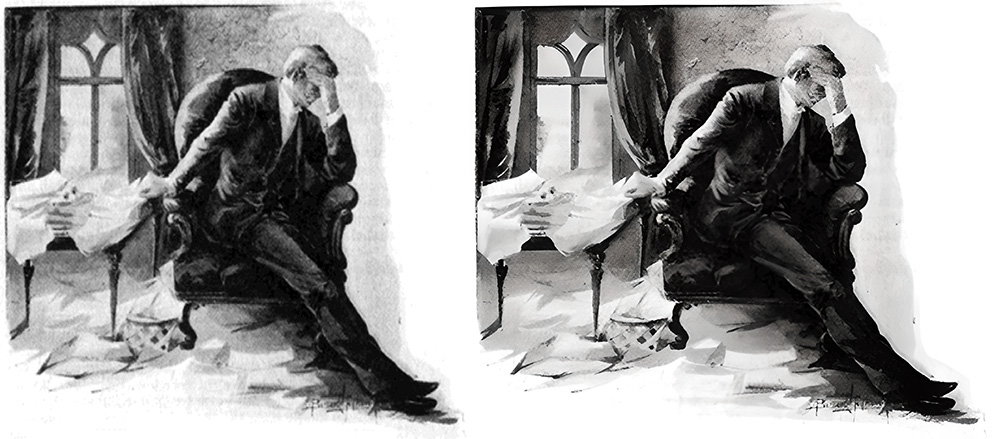
The newly rendered images (of nearly 70 illustrations) allow for the technical reproduction in print format (which typically requires image files of a minimum of 300 DPI). Equally, the new vividness of the images (otherwise dulled through archival processes over the years, with reproduction on micro fiche and/or early OCR scanning) perhaps offers a glimpse of the experience Victorian readers’ might have had when first opening their copy of Ludgate Illustrated, perhaps on the busy commuter train home.
To find out more about how recent AI image diffusion models work, see ‘Automatic Art & the Post-Knowledge Economy’ (particularly the opening sections).
 Pécuchet