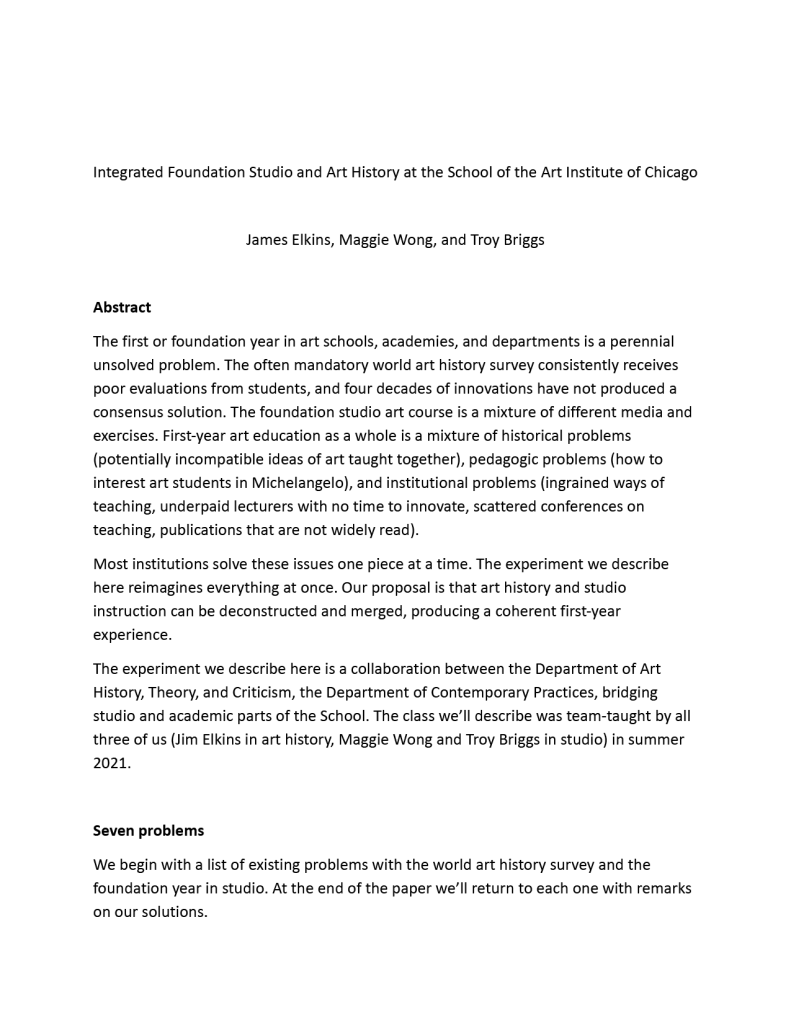
Integrated Foundation Studio and Art History at the School of the Art Institute of Chicago
James Elkins, Maggie Wong, and Troy Briggs
Journal of Visual Art Practice is due to publish an article by James Elkins, Maggie Wong, and Troy Briggs, which explores the Integrated Foundation Studio and Art History at the School of the Art Institute of Chicago. They present an ‘experiment’ undertaken through a collaboration between the Department of Art History, Theory, and Criticism, the Department of Contemporary Practices, bridging studio and academic parts of the School.
| Responses & Commentaries Welcome (for inclusion in the Journal) READ: You can download the pre-print version of the article HERE (or click on the images above) RESPOND: Your views are welcome, with the aim to include responses in the final published version in Journal of Visual Art Practice. You can leave comments in the ‘leave a reply’ box below (visible to others), or alternatively send via email to the editor: s.manghani@soton.ac.uk Commentaries and responses should aim to be between 500 – 1000 words; to be sent by 1 September 2022. |
 Pécuchet
Your responses will appear here when using the ‘leave a reply’ box below.
We welcome commentaries between 500 – 1000 words, with the view to compile a set of responses to be published within the same issue of the final print version of the article. In readiness for publication, please aim to send your commentaries by 1 September 2002.
Please aim to use the house style of the journal. You can view various open access articles as examples, and/or view the ‘instructions for author‘.
I found the structure a way forward! Was an art educator l used ways to incorporate students Art practice with Art history and it was successful with the learning that took place!
If you have recommendartions, a syllabus, stories, etc., write them out. We’re also looking for responses to collect for publication in the journal.
I had developed a personal study sheet when studying fine art images. Including when teaching students .
To develop an understanding of the Fine Artist and their 2D or 3D image
Personal Study Sheet::
Title
Artist
Date
Medium
Dimension
ARTIST SELECTION PROCESS :
Motive
Inspiration
Training
Technique
Circumstance(s)
Economics
Social Prestige
Production
FUNCTION :
Symbol of Unity
Mytho-Religious
Power Structure
Social Cohesion
Didactic
Prestige
Public Display
Burlesque
Entertainment
Disjunction
Academic
OPINION:
This was a studio class?
This is amazing. Such a tremendous amount of work to adapt all that content to the format, but so worth it. It’s the way it should be. Fully integrated. Thanks for sharing. Would be interested in hearing about updates.
How to interest art students in Michelangelo? Why wouldn’t they be interested? You might start with Cangiantismo. And looking at his very muscular female figures has always fascinated my students. The question is how someone of Michelangelo’s stature didn’t avail himself of female models?
Continuing with how to interest art students in Michelangelo-
If you look at the Renaissance as a logical sequence unfolding organically Leonardo comes before Michelangelo, and his interest in proportion is paramount to understanding his art. Michelangelo goes against this classical proportion and distorts the figure. So, there is any interesting tension between the two great artists, on a formal as well as personal level.